
Four Growth Paths Every Small Business Owner Should Know (And When to Use Each One).
Introduction: Why Growth Without Strategy Is Risky.
Every small business owner wants growth. More sales. More customers. Bigger reach. Better margins. I’ve never met a business owner who said, “No thanks, I’m fine exactly where I am.” But here’s what I’ve learned after working with hundreds of entrepreneurs and living it myself: Growth is not a strategy. It’s a goal. And without the right plan behind it, growth can break your business faster than stagnation ever will.
I’ve seen businesses grow themselves into chaos. A marketing agency that landed 6 big new clients in 30 days — and then lost half of them within three months because they couldn’t scale delivery. A retailer who added 20 new products without understanding demand, and ended up with cash locked in stock that didn’t sell. A coach who rushed to build a new audience in a different niche — and lost traction in the market they’d already earned trust in.
In every case, the mistake wasn’t ambition. It was direction. They didn’t think about how to grow. They just assumed “more” was always better.
That’s where Ansoff’s Matrix comes in. It’s one of the most practical, underrated tools for thinking about growth. It breaks strategy down into four clear paths — each with its own risk, reward, and planning approach. In this blog, I’m going to show you:
- What those four growth paths are.
- How to apply them in real business planning.
- And how to choose the right one for your next 90-day sprint.
Because if you’re serious about growing, you need more than good intentions. You need a clear path and the discipline to follow it.
Let’s get into it.
1: What Is Ansoff’s Matrix? (The Four Growth Paths).
When it comes to growth, most business owners are operating on instinct. They want more sales, more leads, more income, but they’re not clear on how to get there. That’s why so many strategies fall apart before they deliver results. There’s no map — just motion. Ansoff’s Matrix gives you the map.
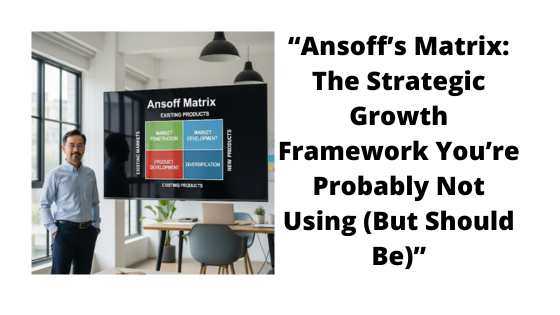
Developed by Igor Ansoff in 1957, it’s one of the most practical tools in strategic planning, especially when your goal is growth. It breaks your strategic options into four clean, simple categories based on two factors:
- Are you selling to your existing market or a new market?
- Are you offering existing products/services or new ones?
Put those together in a 2×2 grid, and you get four growth strategies:

1.1. Market Penetration (Existing Product + Existing Market).
This is the safest growth path. You already have the product. You already know the market. The goal here is simple: sell more of what you already sell, to people you already serve.
Examples:
- Increasing customer retention or repeat purchase rates.
- Running promotions or loyalty programs.
- Improving your sales process or follow-up.
- Taking market share from competitors in your current space.
This is perfect for businesses that are under-leveraged — lots of opportunity, but not maximised yet.
1.2. Product Development (New Product + Existing Market).
Here, you stay in the same market — same customers, same audience — but offer them something new. This is a smart move when you’ve got loyal clients who trust you and want more from you. Examples:
- Adding a premium or budget-friendly version of your existing offer.
- Bundling services or creating add-ons.
- Launching a new product based on customer feedback.
- Turning a one-off service into a retainer model.
It’s medium risk — you know the people, but you’re innovating the offer. You need development time, feedback loops, and a good grasp of your customers’ real needs.
1.3. Market Development (Existing Product + New Market).
Now you’re taking what already works — your proven product or service — and introducing it to a new group of customers. This can be geographical, demographic, or channel-based. Examples:
- Expanding from local to national.
- Launching in a new industry vertical.
- Targeting a new audience segment (e.g. selling to B2B instead of B2C).
- Taking your in-person offer online, or vice versa.
This strategy requires more research and planning. You already know how to deliver the offer, but do you know how to position it for a new market?
1.4. Diversification (New Product + New Market).
This is the highest risk, highest potential reward path. You’re creating something new and selling it to people you’ve never worked with before. Examples:
- A business coach launching a productivity app.
- A local retailer developing a private label product for export.
- A copywriter creating an online course for HR professionals.
It can pay off — but it can also backfire if you jump too early. Diversification should be planned carefully, ideally built on strengths, not shiny object syndrome.
Why This Framework Matters.
Ansoff’s Matrix gives you strategic clarity. It helps you:
- Focus your energy instead of chasing everything at once.
- Plan your next 90-day sprint with precision.
- Understand the real risk profile of your growth decisions.
- Align your actions with your actual goals.
Growth isn’t just about doing more; it’s about choosing where to grow and doing it with intent.
2: How to Apply Ansoff’s Matrix in Small Business Planning.
It’s one thing to understand the theory behind Ansoff’s Matrix — it’s another to use it when you’re planning your next move in the real world. The good news? You don’t need a corporate strategy team or a five-year forecast to make this work. You just need clarity about where you are now and where you want to go next.
Ansoff’s Matrix helps you break the complex idea of “growth” into four manageable, focused directions. When you connect that to your business planning — especially using structured systems like the 365/90 process — you can turn big ambitions into simple, actionable steps.
2.1. Using Ansoff’s Matrix to Choose Your Growth Focus.
Instead of saying, “I want to grow,” the matrix forces you to answer a sharper question:
“Where should that growth come from?”
Each quadrant offers a different path, and the best one for you depends on:
- What’s working now?
- What resources do you have?
- How much risk can you manage?
- Where are the opportunities in your market?
Example:
- You’ve got a steady base of loyal customers, but not enough volume?
→ Focus on Market Penetration (more sales from existing clients). - Your customers keep asking for things you don’t offer?
→ You’re ready for Product Development. - You’re maxed out locally and want to grow online or into new niches?
→ That’s Market Development. - You’re ready to launch something completely different?
→ Consider Diversification (with caution).
2.2. Tie It into Your 90-Day Planning Cycles.
Here’s how it fits beautifully into structured short-term business planning:
- Quarterly planning (365/90) gives you the perfect time frame to act on one quadrant at a time.
- You can set your 90-day strategic outcome based on the growth strategy you choose.
For example:
- Market Penetration: “Increase customer retention rate by 20% over 90 days.”
- Product Development: “Launch and sell a new mid-tier offer to 10 existing clients.”
- Market Development: “Enter the B2B coaching space with 5 new trial clients.”
- Diversification: “Test the launch of an online product in a new niche with 50 signups.”
This approach keeps you focused, reduces overwhelm, and gives you real data to measure what’s working before you commit too far or scale too soon.
2.3. Balance Ambition with Risk Management.
Every quadrant has a different risk profile. That’s the beauty of the matrix — it’s not just about direction. It’s about understanding the weight of your decision.
- Market Penetration = low risk, lower innovation.
- Product Development = moderate risk, requires time to build and test.
- Market Development = higher marketing risk — new audiences mean new messaging, positioning, and trust-building.
- Diversification = high risk, high potential reward — best tackled when cash flow is stable and core business is sound.
This forces a reality check:
Are you taking on a growth strategy that your current business model can support?
If not, scale down your ambition — not because you can’t grow, but because timing and execution matter more than intent.
Growth is never “one size fits all.” What works for someone else’s business won’t always work for yours. Ansoff’s Matrix gives you a smart, strategic filter — so instead of chasing random ideas or jumping on trends, you can choose a path that fits your goals, your stage, and your capacity.
And once you’ve chosen that path, the next step is to execute within it with focus.
3. Strategy #1 – Market Penetration
When most small business owners think of “growth,” they often think of chasing new audiences or creating new offers. But the easiest, lowest-risk way to grow is right under your nose: selling more of what you already offer to people you already serve. That’s Market Penetration.
It’s the safest quadrant in the Ansoff Matrix because you’re not doing anything drastically new — no new product development, no new target market. Instead, you’re asking:
“How can I deepen my footprint in the market I already know?”
3.1 What Market Penetration Means in Practice.
In simple terms: You’re increasing volume, frequency, or loyalty from your existing customer base and ideal market segment. Here are the most common approaches:
3.1.1 Sell More to Current Customers.
- Encourage repeat purchases.
- Introduce incentives or loyalty rewards.
- Offer bulk or subscription options.
Example: A copywriter offers a quarterly content retainer to clients who previously booked one-off blog posts.
3.1.2 Win Business from Your Competitors.
- Sharpen your value proposition.
- Improve your offer or pricing.
- Launch a focused campaign targeting competitor clients.
Example: A virtual assistant agency runs a “We Fix Admin Nightmares” campaign aimed at clients frustrated with their current VA support.
3.1.3 Increase Visibility and Awareness Within Your Existing Market.
- Run paid ads to your core segment.
- Improve SEO for known service/product categories.
- Launch remarketing campaigns.
Example: A fitness coach doubles down on content marketing aimed at busy professionals — the segment she already serves — with clearer messaging and more consistent output.
3.1.4 Improve Your Conversion Rate
- Tweak your sales process.
- Optimise your website, lead magnets, or onboarding journey.
- Remove friction from the buying process.
Example: A business consultant improves her booking flow and email nurture sequence, converting more inquiries into paid discovery sessions and using the same traffic but with better results.
3.2 When Market Penetration Makes the Most Sense.
This strategy works best when:
- You already have a customer base or some traction in your market.
- You’re not yet the “go-to” in your niche.
- Your current market has room to grow without needing new infrastructure.
If you’re still building your brand or proving your model, this is usually your smartest play. It lets you build depth before breadth — and create stronger financial foundations before expanding.
3.3 What to Avoid.
- Don’t assume loyalty is automatic — you still need to earn repeat business.
- Don’t default to discounting — increased volume shouldn’t mean reduced profit.
- Don’t ignore marketing just because you’re not targeting a new audience — consistency is key.
3.4 Business Planning Insight.
If you’re using the 365/90 planning model, Market Penetration is a perfect focus for a 90-day sprint. It’s clear, measurable, and relatively easy to execute. Example 90-day goal:
“Increase average client spend by 20% through upsells and repeat bookings.”
Then build your plan around content, offers, and client experience improvements that support that goal.
4. Strategy #2 – Product Development.
Suppose Market Penetration is about going deeper with what you already sell. In that case, Product Development is about going wider — creating new products or services to sell to the market you already serve.
It’s a smart move for small business owners who’ve already built trust with their audience but want to increase average spend, improve retention, or open up new revenue streams without having to find new customers. Think of it like this:
“They already like me — what else can I offer that adds value and keeps them around?”
4.1. What Product Development Means in Practice.
This strategy involves introducing a new product, service, feature, or version that fits your current audience. Here are common ways small businesses do it:
4.1.1 Add Complementary Offers.
Create something that naturally pairs with your existing service or product.
Example: A brand designer adds a social media graphics pack as an optional upsell to her logo design service.
4.1.2 Launch Higher-Tier or Premium Versions.
For customers who want more access, more speed, or more depth, offer a premium version.
Example: A business coach offers a new “VIP Accelerator Day” in addition to their regular coaching package.
4.1.3 Solve the Next Problem in the Customer Journey.
If you already solve Problem A, develop something that tackles Problem B.
Example: A website developer adds a monthly care plan and analytics reporting service, so clients don’t have to go find someone else to support them after launch.
4.1.4 Create Scalable Versions of 1-to-1 Services.
Turn your process into group offers, digital products, or self-serve tools.
Example: A copywriter builds a DIY sales page template bundle based on her signature 1-to-1 process.
4.2. When Product Development Makes the Most Sense.
This is a great growth strategy if:
- Your customers already trust you, but want more options.
- You’re constantly getting asked for things you don’t currently offer.
- You’ve maxed out your delivery capacity and want to scale without more 1-to-1 work.
- You’re in a mature niche and need to stay ahead of competitors by expanding your offer ecosystem.
This approach increases lifetime value (LTV) without needing more leads — it’s a depth play, not a reach play.
4.3. What to Avoid.
- Don’t build offers in a vacuum — base development on real feedback or proven demand.
- Avoid shiny object syndrome — don’t create something new just because you’re bored with your current offer.
- Don’t complicate operations unless you’re ready to systemise or delegate.
The goal isn’t more products, it’s better-fit offers that serve your market more completely.
4.4. Business Planning Insight.
If you’re using a 365/90 planning approach, Product Development is ideal for a focused, structured 90-day sprint.
Example 90-day goal:
“Launch a new group coaching programme for existing 1-to-1 clients.”
Break the sprint into three phases:
- Validation and offer design.
- Build assets and a delivery plan.
- Promote, sell, and deliver a pilot version.
The key? Stay lean. Start simple. You don’t need a complex new funnel — just a clear offer that meets a real need.
5. Strategy #3 – Market Development.
Market Development means taking your existing products or services and finding new markets to sell them to. You’re not changing what you offer — you’re changing who you offer it to. This is a smart growth strategy when you’ve already proven your offer works in one market and want to expand your reach without having to reinvent the wheel.
“This works here. Who else might want it?”
Unlike Product Development, which focuses on creating something new, Market Development is all about unlocking new customer groups using what you already have.
5.1. What Market Development Looks Like in Practice.
This could mean:
- Entering a new geographic region.
- Targeting a new industry or niche.
- Shifting from B2C to B2B (or vice versa).
- Selling through new platforms or channels.
Here are some real-world small business examples:
5.1.1 Geographic Expansion.
Example: A UK-based business consultant begins marketing to clients in Ireland and Australia using virtual delivery.
How: Run targeted ads, tweak your messaging for local context, and adjust time zones and currencies.
5.1.2 New Customer Segment.
Example: A personal trainer who works with busy professionals repackages their programme for new mums — same framework, different market need.
How: Change your positioning, language, and content to match the priorities of the new audience.
5.1.3 Channel Expansion.
Example: An online coach who relies on referrals builds a presence on LinkedIn to reach corporate clients.
How: Create tailored content, change your offer framing, and run outreach with a new tone.
5.1.4 Industry Pivot.
Example: A VA business that supports creatives adapts its service packages to support busy legal professionals — same skills, different client type.
How: Niche your message, add relevant testimonials, and understand the pain points of the new sector.
5.2. When Market Development Makes Sense.
Choose this strategy if:
- Your current market is saturated or tapped out.
- You’ve had success in one segment and see opportunities in others.
- You want to diversify your client base and reduce dependency on one group.
- You can reach a new market without drastically changing your offer or delivery process.
5.3. What to Avoid.
- Don’t assume your success will transfer 1:1 — new markets require adjusted messaging, tone, and trust-building.
- Don’t overlook the acquisition cost — entering new markets means building brand awareness from scratch.
- Don’t stretch into a market that conflicts with your brand values or operations model.
5.4. Business Planning Insight.
Market Development is perfect for a 90-day test sprint. Don’t go all in — go lean. Pick one new segment or one new channel and focus.
Example 90-day goal:
“Land three clients in a new industry segment using LinkedIn outreach and content.”
Break it down:
- Research and validate the new market.
- Create targeted messaging and a minimum viable offer.
- Build and execute an outreach/content campaign.
- Track results and assess traction at 90 days.
This allows you to explore growth without jeopardising your core business.
6. Strategy #4 – Diversification.
Diversification is the boldest, riskiest growth strategy in the Ansoff Matrix — and potentially the most rewarding. It means offering new products or services to entirely new markets. You’re stepping into unfamiliar territory on both fronts:
“New offer, new audience, new playing field.”
This can be incredibly lucrative if done right, but it requires serious strategic thinking, resource planning, and risk management. For small businesses, diversification isn’t just about “launching something new.” It’s about knowing why you’re doing it and having the systems to support the jump.
6.1. What Diversification Looks Like in Practice.
This strategy often falls into two categories:
6.1.1 Related Diversification.
You create something new, but it’s still connected to your core expertise or audience.
Example: A marketing consultant builds a software tool to help agencies automate reporting. New product, slightly new market — but within the same universe.
6.1.2. Unrelated Diversification.
You step into a completely different market with a new offer that has little connection to your current business.
Example: A wedding photographer starts a DTC skincare line. Totally new business, new customer base, and unrelated to existing services.
6.2. Other Examples for Small Businesses:
- A VA agency launches a training academy to certify new VAs.
- A copywriter creates a physical journal product for content planning.
- A fitness coach partners with a supplement brand to launch a co-branded product.
- A web designer invests in a local café, moving from services to brick-and-mortar.
6.3. When Diversification Makes Sense.
Choose this strategy only when:
- Your core business is stable and well systemised.
- You’ve spotted a genuine gap or opportunity, not just a distraction.
- You’re able to invest time, money, or partnership resources.
- You’re looking to de-risk long-term by creating a second income stream or business model.
Diversification can be incredibly smart — but only after you’ve maximised what already works.
6.4. What to Avoid.
- Don’t diversify because you’re bored — do it because there’s strategic upside
- Don’t assume you can just replicate success — new markets have different rules
- Don’t risk your main income to chase a hunch — protect your foundation while you explore
Reminder: If your core business is wobbly, diversification multiplies your problems, not your income.
6.5. Business Planning Insight.
Diversification is not a 90-day move, but you can absolutely test the early stages of a diversification idea in a 90-day sprint.
Example 90-day goal:
“Validate the demand and test a minimum viable product for a new offer in a new market.”
Breakdown:
- Conduct market research and test messaging.
- Build a lean MVP (e.g. a landing page or waitlist).
- Launch a small pilot or beta group.
- Gather results and decide whether to build or shelve.
You don’t need to commit fully — you need to test fast and learn before you invest.
7: Choosing the Right Path — And Making It Work.
Now that you’ve seen all four strategies in Ansoff’s Matrix — Market Penetration, Product Development, Market Development, and Diversification — the next logical question is:
“Which one is right for my business right now?”
The truth is, all four can be useful — but not all at once. Growth without focus is a trap. And trying to “do a bit of everything” is how most small businesses burn out, dilute their message, and stall momentum. Your goal is to pick one lane, execute it well, and build the capability to expand from a position of strength, not chaos.
7.1. How to Choose the Right Growth Strategy.
Here’s a simple diagnostic:
Choose Market Penetration if…
- You’re still growing in your existing niche.
- You haven’t maximised your repeat business or customer lifetime value.
- You want low-risk, steady cash flow growth.
Use this to deepen trust and optimise performance before expanding.
Choose Product Development if…
- Your customers are asking for more.
- You’re at capacity with your core offer.
- You’re ready to increase average spend per client.
Use this to grow your value per transaction and improve customer retention.
Choose Market Development if…
- You’ve hit a ceiling in your current market.
- You want to reach new audiences with proven offers.
- You see a natural extension into a new segment or region.
Use this to grow reach and reduce reliance on a single market.
Choose Diversification if…
- Your current business is systemised and profitable.
- You have capital (money, time, or team) to test something new.
- You want to build a second stream of income or enter a new industry.
Use this to future-proof your business — but plan for risk.
7.2. What to Avoid When Applying Ansoff’s Matrix.
- Don’t treat it like a checklist — it’s a strategic filter, not a to-do list.
- Don’t bounce between quadrants out of boredom — build discipline, not distractions.
- Don’t forget your delivery systems — more sales mean more strain if you’re not prepared.
Strategy isn’t just picking a direction. It’s being honest about your stage, resources, and focus.
7.3. Link It Back to Business Planning: Use One Growth Strategy Per 90-Day Sprint.
This is where the 365/90 planning model becomes so valuable.
Instead of trying to “grow in all directions,” commit each 90-day sprint to a single Ansoff strategy:
- Q1: Focus on Market Penetration — improve upsells and retention.
- Q2: Focus on Product Development — launch a new premium tier.
- Q3: Focus on Market Development — expand into a new industry.
- Q4: Test the early stages of Diversification with a pilot offer.
This rhythm gives you:
- Clarity.
- Simplicity.
- Consistent execution without overwhelm.
You don’t need 100 ways to grow your business. You just need the right one, right now, and the discipline to follow through.
Final Word: Growth Isn’t Guesswork — It’s a Choice.
There’s no shortage of ways to grow a business. The real challenge? Knowing which path is right for you right now, and having the discipline to stick to it. That’s what makes Ansoff’s Matrix so valuable. It cuts through the noise and gives you four clear options:
- Sell more to your existing market.
- Build new offers for your current audience.
- Take what works into a new market.
- Launch something brand new to someone new.
Each path carries different risks, different demands, and different rewards. But none of them work without a plan. Growth doesn’t happen because you’re busy. It happens because you’re strategic.
Your Next Step: Choose Your Strategy. Plan the Execution.
If you’re serious about growth, you don’t need a bigger to-do list. You need a clear decision, a 90-day plan, and a structure to follow through.
That’s exactly what we build inside the Game Plan Accelerator.
You’ll get:
- A strategic 90-day growth plan based on where your business is now.
- Expert support to refine your offer, market, and metrics.
- A proven execution framework to turn strategy into consistent results.
Hit the button below to learn more about the Game Plan Accelerator.
Choose one path. Commit to it. Execute with precision. Because clarity isn’t a luxury, it’s your next competitive advantage.