
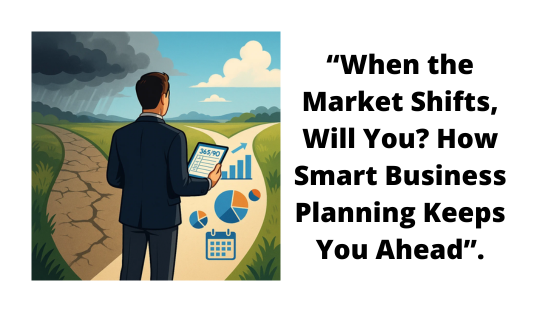
Introduction: Change Is Inevitable — But Failure Isn’t.
If there’s one thing I’ve learned in business, it’s this: the plan is never the problem — the lack of Agile Business Planning is.
I’ve worked with countless small business owners over the years. Many of them started with a decent plan, a solid goal, and a clear vision. But then the market shifted — a competitor launched something new, supply chain costs skyrocketed, customer demand dried up, or the economy decided to throw a curveball.
And just like that, the plan was useless.
Take early 2020 as an example. Businesses with 12-month plans got blindsided. But the ones that had a habit of reviewing every 90 days? They adjusted, pivoted, and in many cases, came out stronger. I saw a fitness coach shift to online sessions and triple her reach. A café owner added a subscription coffee delivery service that now outperforms her physical location. These weren’t lucky breaks. They were intentional responses to change, backed by agile planning.
The truth is, change isn’t the enemy. Inflexibility is.
That’s why I rely on — and teach — the 365/90 planning system. It gives you a clear, focused annual goal (the 365), but breaks it down into 90-day sprints that you can actually manage. And most importantly, it gives you space every 30 days to review what’s working, what’s not, and what’s changed.
Because when your business planning rhythm matches the real-world pace of change, you don’t panic. You adapt.
This blog is about exactly that, how to stay sharp, stay strategic, and stay in control when the market moves faster than your old plan. Let’s dig in.
1. Why Traditional Business Planning Fails in a Volatile Market.
I’ve lost count of how many business owners I’ve met who proudly show me their annual business plan — 20 pages long, neat formatting, detailed forecasts — and then quietly admit they haven’t looked at it since February.
It’s not that the plan was bad. The problem is that the world it was written for doesn’t exist anymore.
Traditional planning assumes stability. It’s based on the idea that if you define a course of action in January, it’ll still be relevant in June. But markets don’t work that way anymore. Economies fluctuate. Customer behaviour shifts. Competitors move fast. Technology makes last year’s idea obsolete in months.
Look at what happened during the 2022 energy price hikes in the UK. I worked with a small manufacturing company that built its entire year around a set of stable utility costs. When prices doubled overnight, their profit margin collapsed. Their annual plan had no room to manoeuvre. They had to rip it up and start again — only this time, under pressure.
That’s what I mean by rigidity.
A traditional plan creates a false sense of control. You think you’ve covered everything, but the first real-world shock exposes how brittle it actually is. And when that happens, most business owners respond in one of two ways:
- They ignore the change, hoping things will correct themselves (they usually don’t).
- They abandon the plan entirely, working reactively and burning out.
Neither is a good strategy.
That’s why I believe the answer isn’t no planning — it’s smarter planning. Your plan should flex with the market, not break at the first sign of disruption.
This is exactly where the 365/90 system comes in. Instead of committing to a rigid 12-month roadmap, you focus on a clear annual goal but work in 90-day execution cycles. Each quarter, you reassess. Each month, you review. That rhythm keeps you grounded in your vision, but agile in your response.
So if you’ve ever felt like your plan went out the window after Q1, you’re not alone. It’s not your fault. You’re just using a system built for a world that no longer exists.
Let’s move on to the one that does.
2. Agile Business Planning for Entrepreneurs: The 365/90 Planning System — Built for Agility and Control.
One of the biggest lies in business planning is that you need a detailed 12-month roadmap to succeed.
I used to believe that too. I’d spend days — even weeks — building out detailed plans, forecasting every line, mapping out every step. But within a few months, reality would laugh in my face. A supplier let me down. A new competitor popped up. The platform I was relying on changed its algorithm. And there I was again… stuck trying to adapt a plan that was never designed to be flexible.
That’s why I developed — and now teach — the 365/90 Planning System.
It’s simple. You set a clear 365-day goal for your business — that’s your North Star. But instead of trying to march blindly toward it, you break the journey into 90-day sprints. Every quarter becomes a fresh execution cycle, with specific, achievable goals tied directly to your bigger objective.
Here’s what that gives you:
- Clarity: You know where you’re going and what matters most now.
- Focus: You only commit to a few core priorities every 90 days.
- Agility: You get a built-in opportunity to course-correct every quarter, without blowing up the whole plan.
But we don’t stop there.
Each 90-day sprint is further broken down into 30-day review windows. That’s where the magic really happens. You don’t wait until the end of the year to find out something’s gone wrong. You catch it early. You learn faster. You adjust smarter.
For example, I worked with a freelance consultant who wanted to double her income in 12 months. In the first 90-day sprint, we focused purely on packaging and pricing. At the 30-day mark, it became clear one of her offers wasn’t landing. We didn’t panic — we just restructured it. By the end of the quarter, she’d signed two new retainers, both at higher prices than before.
That’s the power of this system. It respects the long game, but it plays it in short, tactical bursts.
If you’ve been stuck in the feast-or-famine cycle, constantly reacting instead of leading, the 365/90 model gives you back control, without sacrificing flexibility.
Next, I’ll show you how this system helps you actually see market changes coming — and how to respond before it’s too late.
3. Spotting and Responding to Market Signals in Real-Time.
If there’s one skill every small business owner needs to sharpen, it’s the ability to read the room — or in this case, the market.
Markets rarely scream when something’s wrong. They whisper. A dip in engagement. A new competitor creeping in. A customer hesitating just a little longer before saying “yes.” These are pricing signals, demand shifts, and competitive moves — and they’re easy to miss if you’re not paying attention.
I’ve seen this play out time and again. I worked with a coaching business that noticed discovery call bookings were slowing down, but only slightly. The owner chalked it up to a “quiet spell.” Three months later, sales had dropped 40%. What had actually happened? A new competitor entered the space offering similar services at a higher perceived value and price, and the market moved.
The difference between a minor slowdown and a major problem is often how quickly you respond.
That’s why the 365/90 system isn’t just about execution. It’s about observation and adjustment. It’s about Agile Business Planning.
Every 30 days, you review what’s working, what’s flatlining, and what’s drifting. You ask:
- Are my customers still engaging with this offer the same way?
- Has anything shifted in the market that I need to respond to?
- What’s my conversion rate telling me?
- Am I winning the right type of customer, or losing them?
This isn’t guesswork. It’s built-in reflection that lets you spot small cracks before they become structural failures.
Another client of mine — an e-commerce brand — picked up on a subtle shift in customer buying behaviour. During a 30-day review, they noticed that higher-priced bundles were outselling entry-level offers. Instead of trying to fix what wasn’t broken, they leaned in, repackaged their product line, raised prices, and saw a 27% lift in average order value in the next 90-day sprint.
That’s the kind of real-time response most business owners want — but rarely get when stuck in outdated annual planning loops.
With the 365/90 system, you’re not flying blind. You’re scanning the market regularly, tweaking as you go, and always moving with purpose, not panic.
4. Building Strategic Resilience into Your Plan.
Let’s be honest — resilience gets talked about a lot, but rarely in practical terms.
Most people hear the word and think “grit” or “toughness.” And while yes, you need those qualities, real strategic resilience isn’t just about pushing through. It’s about being prepared — structurally — to flex and adapt without falling apart.
That’s exactly what the 365/90 system allows you to build into your business.
When I talk to small business owners, one of the biggest pain points I hear is, “I just didn’t see that coming.” Whether it’s a sudden dip in customer demand, supplier issues, or a competitor going aggressive on price, it’s the surprise that hits hardest. But most of those surprises aren’t actually surprises. They’re signals you missed… because your plan didn’t include built-in resilience checks.
That’s where the 30-day and 90-day reviews come in.
Instead of waiting for an annual crisis, you’re checking key assumptions regularly:
- Is my target market still behaving the way I expect?
- Are my key products or services still pulling their weight?
- Do my marketing efforts still align with how people are buying right now?
- Is my cost base creeping up while margins stay flat?
When you’re asking these questions every month or quarter, you get ahead of the curve, not behind it.
I once worked with a design agency that relied heavily on one major client for 60% of its income. Every review cycle, we challenged that exposure. Eventually, we built a diversification plan — and it’s a good thing we did. That client left six months later. Because we were ready, they didn’t crash. They adapted and survived — not out of luck, but through planning.
Resilience also means having scenarios in your back pocket. What if sales dip 20%? What if costs spike? What if a new player enters your niche? The goal isn’t to be paranoid — it’s to avoid panic. You make smarter decisions when you’ve thought through outcomes before you’re in the middle of one.
And here’s the best part: building resilience doesn’t mean slowing down. It means moving with more confidence. It means planning with options, not just one fragile path.
So if you want to stop treating every shift like a crisis, start embedding flexibility, reflection, and contingency right into the way you plan.
5. Real Examples of Small Businesses That Pivoted Using 365/90.
One of the things I love most about the 365/90 system is that it’s not theory. It works in the real world — with real businesses, facing real pressure. I’ve seen it help business owners shift direction, stay in control, and grow when others were stuck or shrinking.
Let me share a few examples that highlight just how effective this approach can be.
Example 1: From Local to Global – The Online Fitness Coach.
I worked with a solo fitness coach whose revenue relied entirely on in-person sessions. When the lockdowns hit, her business stopped overnight. Instead of waiting it out, we put a 365/90 plan in place.
In the first 90-day sprint, she built a digital product — a 6-week program filmed on her phone. By month two, she’d sold her first 20 copies. In the next sprint, we introduced live Zoom classes and a simple membership model. Within six months, she wasn’t just surviving — she had tripled her audience and built a recurring income stream that gave her more freedom than before.
That pivot wasn’t about being lucky. It was about having a system that helped her focus, act fast, and review regularly.
Example 2: The Retailer Who Read the Signals Right.
A small homewares store I worked with was heavily reliant on footfall from tourists. But when travel patterns changed, foot traffic dropped, and panic set in. Instead of slashing prices or hoping things would return to normal, we used their next 90-day plan to shift online.
We audited their bestselling products, rebuilt their website, and started collecting emails at the till. Sales were slow at first — but during the 30-day review, we noticed that one product range was outperforming the rest. So we focused on it. In the next sprint, we ran targeted email campaigns and partnered with a local influencer. Online sales surpassed lost in-store revenue — and kept climbing.
Again, this wasn’t magic. It was method.
Example 3: The Consultant Who Reclaimed His Time.
Then there’s the business consultant who came to me overwhelmed, underpaid, and burned out. He had no structure — just a calendar full of low-fee clients and a to-do list that never ended.
We applied the 365/90 framework to rebuild everything: pricing, client targeting, offer structure. Every sprint had a single focus. In Q1, we raised his rates and dropped the bottom 20% of clients. In Q2, we automated his onboarding and implemented a simple lead magnet funnel. By Q3, he had halved his workload and doubled his income.
What changed? Not his talent — that was always there. What changed was how he planned, tracked, and executed.
These stories aren’t outliers. They’re what happens when you stop reacting and start leading — with a system that supports real growth, even in uncertain times.
Final Word: Take Control of Change Before It Takes Control of You.
Here’s what I’ve learned after years of mentoring small business owners: change isn’t what breaks you — it’s your reaction to it.
You can’t control the economy. You can’t predict what your competitors will do. And you certainly can’t forecast every customer shift. But what you can control is your ability to adapt, adjust, and respond — with a clear head and a solid plan.
That’s what the 365/90 system is really about.
It’s not just a planning framework — it’s a mindset shift. It helps you move from being reactive and overwhelmed to being proactive and intentional. It gives you a structure that’s agile but focused, short-term enough to make progress, but long-term enough to drive meaningful growth.
And once you’ve used it, you’ll wonder how you ever ran your business without it.
I’ve watched clients pivot entire business models, scale up with confidence, simplify operations, and finally feel in control again — all because they started planning smarter.
So here’s my challenge to you: Stop relying on static, outdated business plans. Stop guessing and hoping things will just “settle down.” Start building a system that lets you lead through change, not lag behind it.
You don’t need a crystal ball. You need a rhythm. You need 365/90.
Ready to Take Back Control?
If you’re tired of reacting to change and ready to lead your business with clarity and confidence, let’s talk.
Book a free 30-minute 365/90 Business Review with me.
In just half an hour, we’ll:
- Identify what’s holding your business back right now
- Uncover the key market signals you might be missing
- Outline a focused 90-day action plan to help you move forward fast
No fluff. No pressure. Just clear, strategic insight designed to get you unstuck and moving with purpose. Click here to book your 30-minute review now – and start agile business planning like your business depends on it, because it does.